
Showing posts with label mycology. Show all posts
Showing posts with label mycology. Show all posts
Tuesday, February 3, 2015
Mushrooms poisonous to dogs
Often times dog owners worry about mushrooms that their dog has eaten. Some mushrooms may be very serious, but most are no worries. If your dog has eaten a possibly poisonous mushroom, the best thing may be is to find where he/she ate it and collect a specimen. This will give veterinarians an idea of what it ate. You also can refer to mushroom forums with various features of such mushroom in hopes to get it identified, Although there are poisonous mushrooms in this world, usually dogs will not eat any mushrooms at all. Some dogs have been known to be bred for hunting mushrooms so they may as well be able to tell the difference between poisonous and edible with their super smelling senses.

Monday, February 2, 2015
Mushroom identification
Mushroom identification to the average person seems difficult at first. But luckily, in this time we are in the the age of information and plenty of articles or books can be found. Some good websites for people starting out are mushroomobserver.org where people can vote on the species mushroom you've found. Also, shroomery.org message forums are a great place for help for much of anything concerning fungi. Other various forums work well too but sometimes it may take a bit of getting to know people before you get help. Books can be bought on Amazon or at local book stores. I've felt quite confident myself while using a field guide mushroom hunting. The descriptions of habitats helps quite a lot as well. Most books contain simple keys to identification, plus location of your discovered fungi helps zero down the possible choices. Still, some mushrooms require microscope work for further measurements in order to identify.
Sunday, February 1, 2015
Psilocybe cyanescens, a video
I found these all growing downhill and had to take a video. Don't forget to hit the like or subscribe button if you liked it. :)
These were found near the edge of a conifer line in an extremely public park. This season, the patch has been going since November and I've still been finding a few every week I go. Psilocybe mushrooms; especially cyanescens, really like public and lots of traffic. I've noticed with this patch in certain there was always deer poop and some of the woodchips moved away which makes me think either squirrels or deer are the reason they have spread to this location. Sometimes the busiest areas host them and nobody bothers, meanwhile others will rip them up at first glance.
These were found near the edge of a conifer line in an extremely public park. This season, the patch has been going since November and I've still been finding a few every week I go. Psilocybe mushrooms; especially cyanescens, really like public and lots of traffic. I've noticed with this patch in certain there was always deer poop and some of the woodchips moved away which makes me think either squirrels or deer are the reason they have spread to this location. Sometimes the busiest areas host them and nobody bothers, meanwhile others will rip them up at first glance.
Mushroom indentification for everyone
So you're probably wondering how to figure out exactly which mushrooms are good and what is bad? The first step would be getting a book. Libraries have been known to have mushrooms books but are rarely in stock. The best place I would recommend is Amazon. A few good authors are Paul Stamets, David Aurora and Gary Lincoff. They all have various books for areas as some states wont have the same mushrooms. "All that rain promises and more" by David Aurora was my first book and it pretty much covered everything that I came across for the most part. A better, more in-depth book by the same author is "Mushrooms Demystified". Its almost too much information to take in all at once but a great guide that includes it all.


Psilocybe pelliculosa
Psilocybe pelliculosa are saprophytic found mostly on decaying alder woods near clear cut areas. These "magic" fungi do not mind frost as much as many other mushrooms do, making them more relevant in higher and lower elevations near end of fall. Often these are found in large groups or clusters rarely cepitose, but possible. Alike Psilocybe semilanceata, pelliculosa also have a separable pellicle.


cepitose - singular; or stand-alone
separable pellicle - transparent tissue overlayed on cap


cepitose - singular; or stand-alone
separable pellicle - transparent tissue overlayed on cap
Jelly mushrooms
Jelly mushrooms belong to a wide diverse group in the basidiomycetes. Many species must be closely evaluated under microscope before determining. Most jelly fungi swell when it rains, then shrink back up during warm periods or sun. Notable jelly mushrooms are Tramella fuciformus and Pseudonym gelatinosum. Also included in jelly mushrooms are slime molds. Technically they aren't mushrooms or even fungi, but still occur in this category.

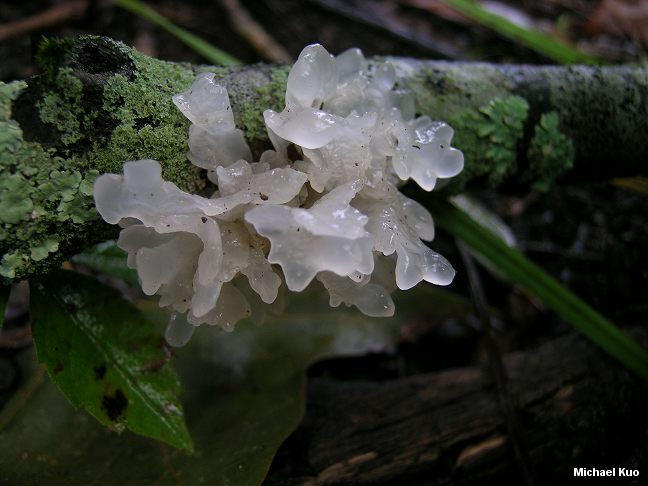
Above: Tramella fuciformus
Ganoderma applanatum (Artist's Conk)
Ganoderma applanatum are really interesting mushrooms being both parasitic and having medicinal properties. Artists conks are probably one of the most widely distributed mushrooms, most commonly found on fallen fir trees. Usually when parasitic, these conks attack bases of trees and later can be found along the tree, sometimes saprobic. The medical value of these mushrooms are comparable to that of Ganoderma lucidium (or shaga). Some being, anti-tumor, anti-inflammatory, anti-carcinogenic, and reducing phlegm. Ganoderma have been consumed by forum of tea for decades, possibly centuries ago. Often it is ground up and added to tea, then strained. One person who swears by its effects said, "You can feel its medicinal properties start working almost instantly like waves".


Wednesday, January 28, 2015
Pseudonym gelatinosum
The other day I was inspired by a friend informing me about Pseudonym gelatinosum. Pseudonym gelatinosum is a jelly mushroom that lacks much flavor and has a gelatin feel and appearance to it. The underside of the cap has these small teeth-like spines and appears to need a shave. These jelly mushrooms are saprobic on woody debris or well decayed conifer logs. I kept finding them near extremely mossy hillsides facing towards the direction of sun rise.


These mushrooms are known to be made into candy, jellies and soups. Most west coast versions of jelly mushrooms are edible, but some must be cooked before eating.
Saprobic - feeds on decaying or dead organic matter


These mushrooms are known to be made into candy, jellies and soups. Most west coast versions of jelly mushrooms are edible, but some must be cooked before eating.
Saprobic - feeds on decaying or dead organic matter
Monday, January 26, 2015
Amanita muscaria
Amanita muscaria are some of the most controversial mushrooms.Most people believe that they contain poison but actually is a deliriant of sorts. These red and white toadstools became popular after being depicted with Christmas themes. Reindeer were thought to have eaten them to be able to fly. There is much fantasy talk about them.


Its no wonder such fairy tales have been made. These mushrooms are mystical and you can tell just by looking at them.

Above: Button form possible Amanita muscaria var. guessowii
Below: Fully grown

Its no wonder such fairy tales have been made. These mushrooms are mystical and you can tell just by looking at them.
Updates in progress... Under construction...
So as you can tell, this blog is just now starting up recently. I strive to photograph all of the mushrooms that I can possibly find. Each mushroom has some beauty in it, but not every mushroom is edible. I'll be doing more work here soon and sharing many pictures that I have taken throughout the last few years. Here's just a sample of what is to come.


Above: Psilocybe cyanescens; very potent psychedelic
Below: Gymnopilus luteofolius; mildly psychedelic

As I mentioned above, not all mushrooms are edible. As this mushroom below is considered toxic. For years people believed Paxillus involutus was edible if cooked thouroughly, but folk were wrong as some had allergic reactions and fell very ill. Sometimes dying. Although mushrooms can be poisonous, its quite easy to become aware with the bad as you study further into mycology. Mushroom books create a safe haven for identification along with various websites that host forums for identification, (I.E. Shroomery.org).

Above: Paxillus involutus; poisonous, can be fatal
Below: Galerina Autumnalis; very deadly

Monday, May 12, 2014
Welcome
Hello, I'm an avid mushroom hunter and I'm going to be posting all my pictures on here and talking about the adventures that I embark to find mushrooms of all kind. I usually just go looking in all types of terrain whether mountains, trails, rivers, lakes, streams, meadows or forests. Some species, however, are more set in habitat or growing mycorrhizal with trees. For example, these chanterelles love to grow underneath pine trees before the hard freeze of winter. This last year was amazing for chanterelles. Upon finding one, you could find multiple flushes nearby.


These are called Cantharellus formosus or commonly known as the pacific golden chanterelle.
Mycorrhizal - A symbiotic (generally mutualistic, but occasionally weakly pathogenic) association between a fungus and the roots of a vascular plant.
Subscribe to:
Posts (Atom)